

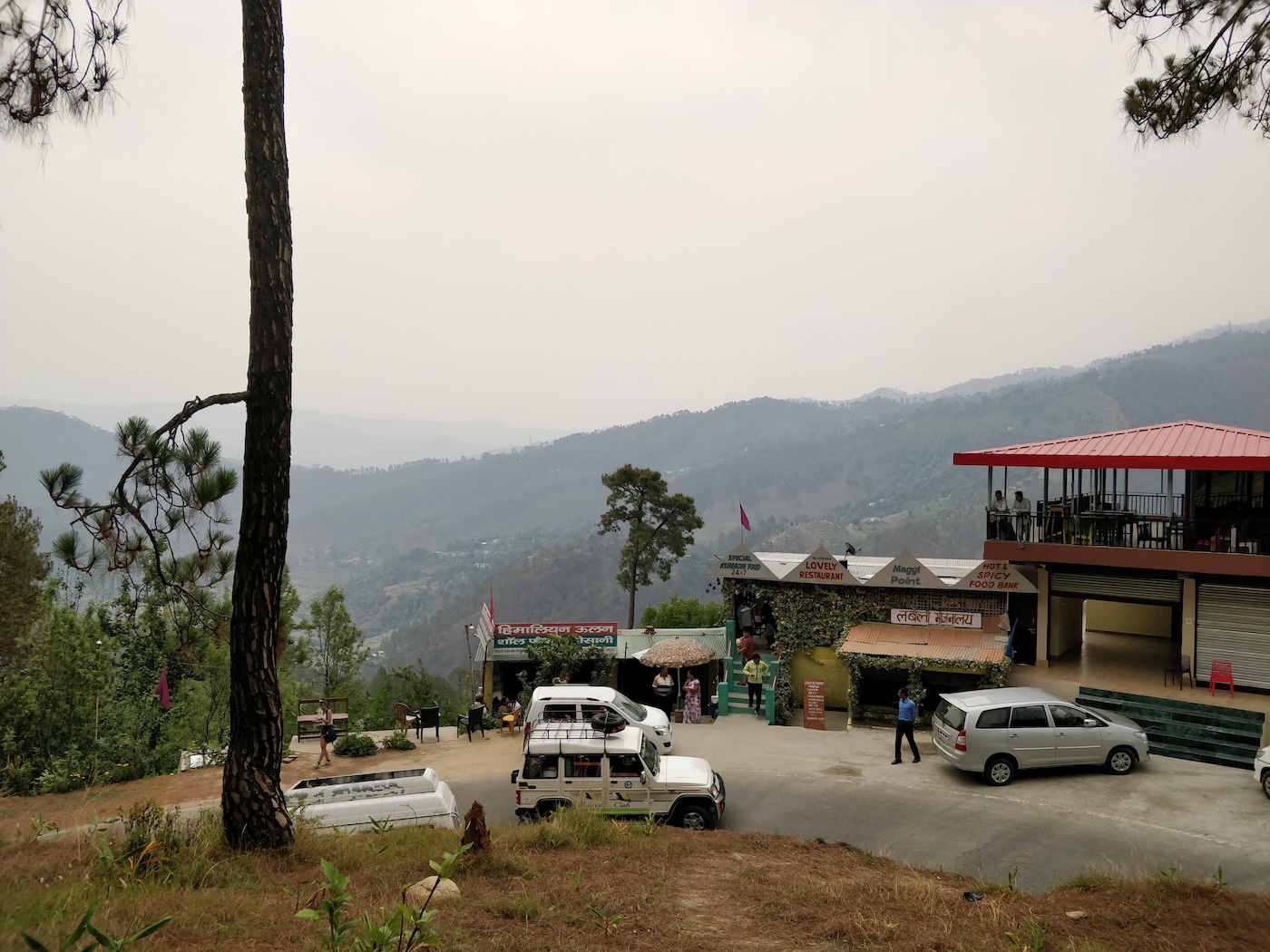
3 Days in Kausani - The Himalayan Escape We Didn't Know We Needed

In this post
- Day 1: Noida to Kausani - The Long, Beautiful Grind
- Day 2: Tea, Temples, and a Waterfall - The Full Kausani Experience
- Sunrise at Anasakti Ashram
- Kausani Tea Estate
- Sumitranandan Pant Gallery
- Rudradhari Falls and Caves
There are trips you plan for months, and then there are trips that happen because someone drops a photo in the group chat at 11 PM on a Tuesday. Ours was the second kind.
Rohan sent a picture - a balcony somewhere in the mountains, a cup of chai in the foreground, and behind it, a wall of snow-capped peaks stretching across the entire horizon. No filter. No caption needed.
"Kausani," he typed. "This Friday."
By Thursday night, four of us were stuffing bags into the boot of a Creta in Noida.
Day 1: Noida to Kausani - The Long, Beautiful Grind
We hit the road at 4 AM. The logic was simple: beat Delhi-NCR traffic or die trying.
The route was straightforward - Noida → Ghaziabad → Hapur → Moradabad → Haldwani → Almora → Kausani. About 420 km on paper. About 11 hours in reality, including three chai stops, one argument about music, and a 40-minute detour because Google Maps decided a village road counted as a "highway."
The first half - Noida to Haldwani - is flat, boring, and relentless. NH-9 is functional but forgettable. We survived on bad coffee and worse puns.
But then you cross Kathgodam, and everything changes.
The road starts climbing. Pine forests appear out of nowhere. The temperature drops by 5 degrees in the span of 20 minutes. Windows go down. Playlist goes off. Nobody talks for a while - everyone's just… looking.
We took the Almora route, winding through the Someshwar Valley. If you've never driven through Someshwar, imagine terraced rice paddies stacked like green staircases on hillsides, a river gleaming at the bottom, and not a single billboard in sight. We stopped at the Someshwar Mahadev Temple - a quiet, 16th-century Shiva temple that most tourists speed right past. That was a mistake we didn't make.
We reached Kausani around 5 PM. Checked into our guesthouse, dropped our bags, walked to the balcony - and then we just stood there.
A 300-kilometre-wide panorama of the Himalayas. Trishul. Nanda Devi. Panchachuli. All of them, right there, glowing orange in the fading sun. Nobody reached for their phone for a solid two minutes. That's how you know a view is real.
Dinner was at a small local restaurant near the market - rajma chawal, aloo ke gutke (spiced potatoes with that signature Kumaoni jakhya tempering), and hot dal. Simple food. Mountain portions. Exactly what we needed after 11 hours on the road.
Day 2: Tea, Temples, and a Waterfall - The Full Kausani Experience
Sunrise at Anasakti Ashram
The alarm went off at 5:15 AM. Nobody wanted to get up. Everyone got up anyway.
We walked to Anasakti Ashram - also known as the Gandhi Ashram, because Mahatma Gandhi stayed here in 1929 and reportedly said he never wanted to leave. Standing there at 5:30 in the morning, watching the first light hit Nanda Devi, I understood why.
The peaks don't just "appear." The light creeps across them - first a faint pink, then gold, then blazing white. The whole process takes about twenty minutes. It's silent. It's freezing. It's easily the most beautiful thing I've seen in Uttarakhand.
Pro tip: Reach 15 minutes before sunrise. Bring a jacket. Don't bring expectations about going back to sleep.
Kausani Tea Estate
By 9 AM, we were walking through the Kausani Tea Estate - 208 hectares of neatly terraced tea bushes sloping down a hillside with the Himalayas as a backdrop. The estate produces organic tea: green, black, and a local special - Buransh (Rhododendron) tea.
We took the guided tour, watched the plucking process, learned more about tea oxidation than we'll ever need, and then sat in the factory shop drinking fresh cups of their green tea. Bought packets for everyone's mother. That's just what you do.
The walk through the tea gardens is easy and takes about an hour. Wear decent shoes - some paths are uneven - but it's nothing strenuous. Perfect for that post-sunrise, pre-lunch window.
Sumitranandan Pant Gallery
A quick stop, but worth it. This small museum is dedicated to Sumitranandan Pant, one of Hindi literature's greatest poets, who was born right here in Kausani. The gallery houses his manuscripts, personal belongings, and photographs. Even if you're not a literature person, the building itself - set among pine trees - has a charm that makes you pause.
Rudradhari Falls and Caves
After lunch, we drove to Kantali village (about 12 km from Kausani) and trekked to Rudradhari Falls. The trail is roughly 2 km through pine forests and terraced paddy fields. Easy walk. Beautiful path. Zero crowd.
The waterfall cascades about 150 feet over a rocky cliff. It's not Niagara, but there's a small cave temple dedicated to Lord Shiva at the base, and the whole setting - water, moss, ancient stone - feels like something out of a Kumaoni folk tale.
We spent about an hour here, sitting on rocks, doing absolutely nothing. Sometimes that's the whole point.
Important: Carry water and snacks. There are no shops past Kantali village. Wear proper shoes - the last stretch gets slippery.
Evening: Starscapes Observatory
This was the unexpected highlight.
Starscapes runs a proper observatory near Anasakti Ashram with professional-grade telescopes. We booked an evening session (they stay open till about 10-11 PM) and spent two hours looking at the rings of Saturn, the craters of the Moon, and the Milky Way arching over the mountains.
The guide knew his stuff - constellations, nebulae, astrophotography tips. For four guys who grew up under Noida's light pollution, seeing this many stars was genuinely surreal. Book in advance if you're going with a group.
Day 3: Baijnath Temple and the Drive Back
Baijnath Temple Complex
We checked out early and drove 17 km to Baijnath - an ancient temple complex on the banks of the Gomti River, built by the Katyuri Kings in the 12th century.
This isn't your typical tourist temple. It's an ASI-protected complex with 18 stone shrines, intricate carvings of Ganesh, Surya, Brahma, and Kubera, and a main sanctum dedicated to Lord Shiva as Vaidyanath - the Lord of Physicians. According to local legend, Lord Shiva and Goddess Parvati were married at the confluence of the Gomti and Garur Ganga rivers right here.
We spent about an hour exploring. The craftsmanship on these 800-year-old stones is staggering - detailed enough to make you forget you're holding a phone.
Quick detour: if you're hungry after Baijnath, stop at one of the small dhabas along the road and ask for a Kumaoni thali. Bhatt ki churkani (black soybean curry), mandua ki roti (millet flatbread), kafuli (spinach-fenugreek curry), and fresh ghee. That's not a meal - that's an experience.
The Drive Home
We left Baijnath around 11 AM and took the same route back - Almora → Haldwani → Moradabad → Noida. Reached home by 10 PM.
The plains felt louder. Flatter. Hotter. Nobody said it out loud, but everyone was already thinking about the next trip.
The Practical Stuff
Route: Noida → Hapur → Moradabad → Haldwani → Kathgodam → Almora → Someshwar → Kausani (~420 km, 10-12 hrs)
Best time to go: October to February for crystal-clear Himalayan views. March to June for pleasant weather and green valleys. Avoid monsoon (July-August) - landslide risk on mountain roads.
Budget (per person, 3 days):
- Fuel (shared): ₹2,500-3,000
- Stay (budget guesthouse, shared room): ₹800-1,200/night
- Food: ₹500-700/day
- Starscapes session: ₹800-1,200
- Miscellaneous: ₹500
- Total: Roughly ₹6,000-8,000 per person
What to pack:
- Warm layers (even in summer, mornings are cold)
- Comfortable trekking shoes
- Power bank (network can be patchy)
- A book - the kind of place that makes you want to read
Don't miss:
- Sunrise from Anasakti Ashram
- Starscapes Observatory (book ahead)
- Kumaoni thali at a local dhaba
- The drive through Someshwar Valley
Skip:
- Trying to "cover everything" - Kausani rewards you for slowing down
One Last Thing
There's a reason Mahatma Gandhi looked at these mountains in 1929 and didn't want to leave. There's a reason the poet Sumitranandan Pant wrote his greatest works here. Kausani doesn't shout. It doesn't have adventure parks or rope courses or Instagram cafes with neon signs.
It has mountains. It has tea. It has silence.
And sometimes, that's more than enough.
Published in mountains, Kausani, Uttarakhand
You Might Also Like

Meet Travelmetry:- The AI Travel Planner That Pays You to Explore the World

Share Your Journey:- How to Write Travel Stories on Travelmetry and Earn Rewards
Road Trips from Pune: 10 Drives Under 300 km That Hit Different on a Weekend
Discussion (0)
Join the conversation! Sign in to share your thoughts.
No comments yet. Be the first to start the discussion!